Rudbeckia keeps flowering — but only if you take the seed away
By early August a good clump of rudbeckia is a wall of gold, and every one of those daisies is quietly heading toward the same finish line: a ripe seedhead. That is the plant’s whole ambition. Once a flower is pollinated, the plant starts pouring sugar into the black central cone to fatten the seed, and it eases off making new buds — because as far as it is concerned, the job is done.
Deadheading breaks that deal. Snip the flowers off as they fade and the plant never gets to bank its seed, so it keeps trying — throwing fresh buds from the leaf joints below. On a black-eyed Susan that is the difference between a display that peters out in early September and one that carries colour into October, right up to the first proper frost. It is the single most useful thing you can do for rudbeckia this month, and it takes ten minutes with a pair of snips.
The catch is where you cut. Beheading the plant — pinging off just the spent cone and leaving a bare green stick behind — does almost nothing, and leaves the border looking like a field of drinking straws. The whole gain is in following the stem down.
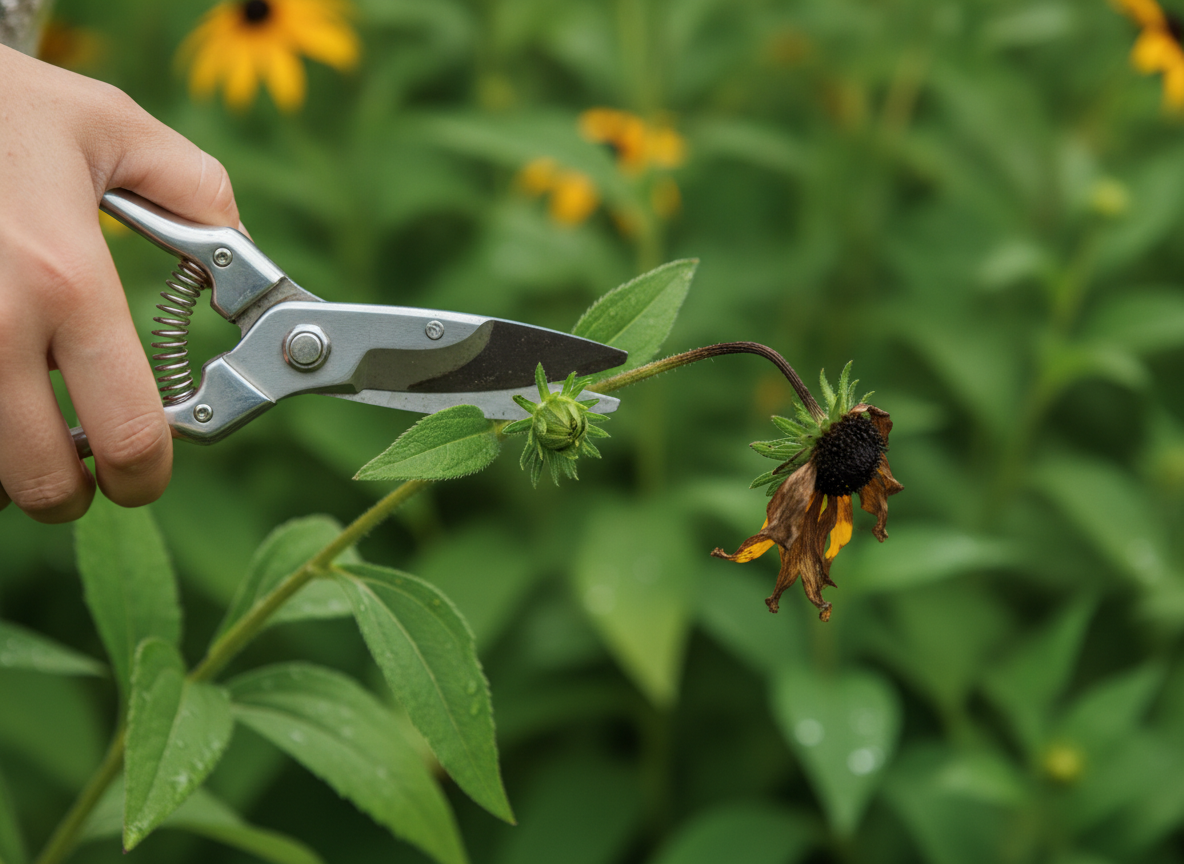 Cut to the next leaf bud: a hand uses pruning shears to deadhead a rudbeckia stem — AI-generated illustration
Cut to the next leaf bud, not just the flower
Look below a faded flower and you will see the stem carries pairs of leaves, and tucked in where each leaf meets the stem is a small side shoot or a fattening bud. Those are the plant’s next flowers, already queued up. Your cut wants to land just above one of them.
So don’t snip at the top of the stalk. Trace the flowered stem down to the first healthy leaf joint that has a visible bud or side shoot, and cut cleanly about half a centimetre above it. The plant reads that as “the tip is gone, promote the reserves,” and the side shoot runs away into a new flowering stem within a week or two. On a branching plant you often remove a whole spent sprig back to a lower fork, taking three or four brown daisies in one cut and redirecting everything into the fresh growth beneath.
A few things that make it pay off:
- Use something sharp. Snips or fine secateurs give a clean cut that seals fast. Rudbeckia stems are wiry, and a ragged tear left by fingers or blunt blades invites rot in muggy August weather.
- Don’t leave stubs. A long bare stalk above the next bud just dies back and looks untidy. Cut close.
- Keep up with it. Deadheading is not a one-off. Walk the clump every week or so through August and September; five minutes each time beats an hour of catch-up.
- Water first if it’s bone dry. A drought-stressed rudbeckia will not push a second wave however hard you deadhead. In a hot, dry spell, a good soak at the roots does as much as the snips.
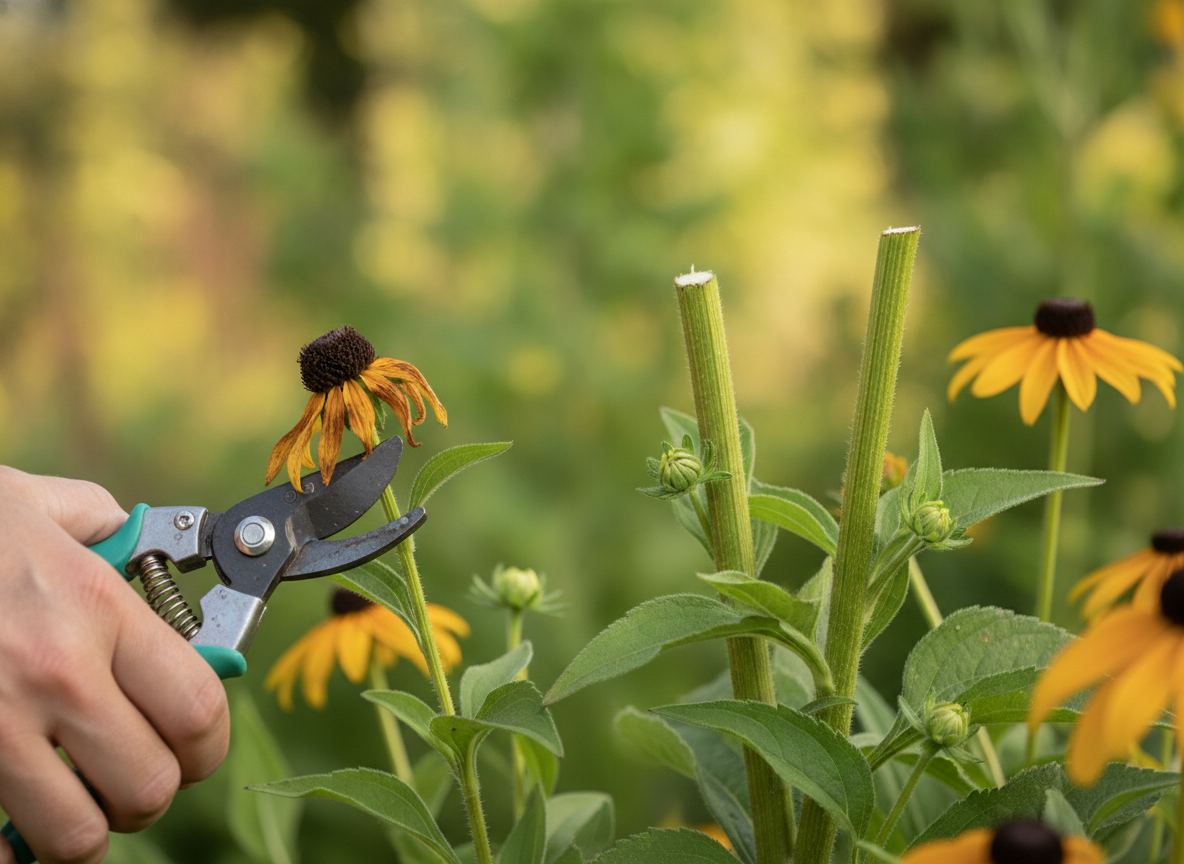 Deadheading a healthy plant, not shearing it: snipping spent rudbeckia heads while the clump stays in bloom — AI-generated illustration
Deadheading isn’t the same as cutting the plant back
There is a bit of advice that does the rounds every summer: if a rudbeckia looks tired, chop the whole thing down to 10–15 cm and it will flush again. That is true — but it is a rescue for a neglected, mildew-ridden, or badly flopped plant, not a routine August job, and doing it now to a healthy plant in full bloom is a mistake.
In early August your rudbeckia is still building and opening buds it set weeks ago. Shear the clump to the ground now and you throw all of that away, and the plant has to start over in the shortening days of late summer — when there simply isn’t the light or the warmth left to give you the second wave you were hoping for. You often end up with a tuft of leaves and a handful of late, weak flowers instead of six good weeks of colour.
So keep the two jobs separate. August is for deadheading — precise cuts to lower buds, plant left standing and flowering. The hard cut-back is a spring job, once the winter-standing stems have done their work (more on that below). The only time to take shears to a rudbeckia in high summer is triage: a plant that has collapsed, gone over completely, or is grey with mildew, where a hard chop and a feed is genuinely the lesser evil.
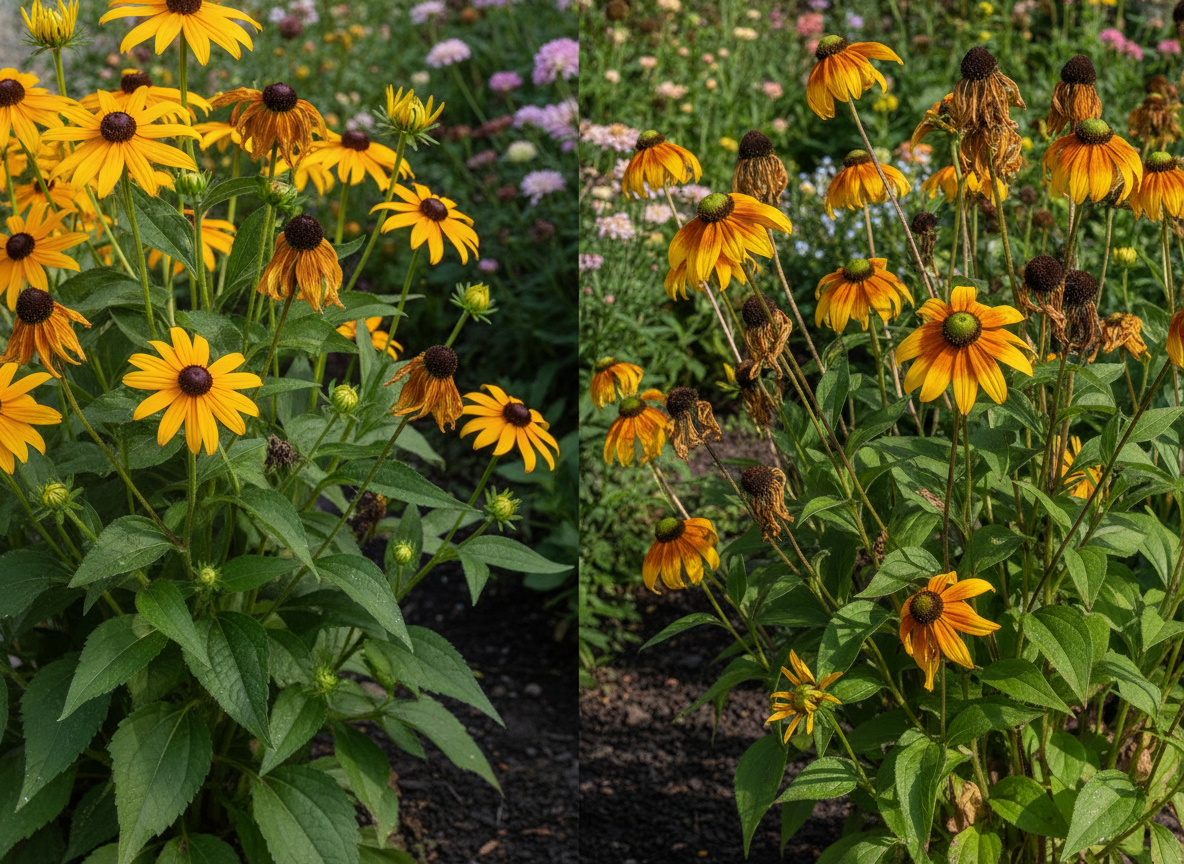 Garden with two types of rudbeckia, one deadheaded and one not — AI-generated illustration
Which rudbeckia this works on — and the one it doesn’t
“Rudbeckia” covers a few very different plants, and deadheading pays off most on some:
- Rudbeckia hirta (the classic annual and short-lived black-eyed Susans — ‘Marmalade’, ‘Cherry Brandy’, ‘Sahara’). These are effectively annuals, running hard toward seed. Deadheading matters most here — let them set seed and they genuinely wind down and die; keep them cut and they flower for months.
- Rudbeckia fulgida (‘Goldsturm’ and friends — the standard hardy border perennial). Perennial, so it returns whatever you do, but deadheading still stretches the display by weeks and keeps the clump neat and dense rather than seedy.
- Tall species like Rudbeckia laciniata and ‘Herbstsonne’. Same principle, just up a ladder — deadhead the spent branches back to a lower fork.
The one to leave alone is any rudbeckia you are deliberately keeping for seed — whether to save your own ‘Goldsturm’ seed or to feed the birds. And that is the thread that runs into the end of the season.
When to stop: the last cones earn their keep
Deadhead hard through August and September, then ease off as October comes. The last flush of cones is worth leaving standing: those black seedheads are goldfinch food through autumn, they hold frost and low winter sun beautifully, and they shelter the crown of the plant. This is exactly the call we make with coneflowers too — the reasoning, and the “leave the last, cut the rest” rhythm, is spelled out in our piece on why the last coneflowers are best left for the birds. The hard cut-back then waits until early spring, when you clear the collapsed stems before new growth pushes.
If you want to squeeze a bit more out of the border without losing next year’s plants, deadheading rudbeckia sits alongside the other late-summer trick of cutting tired perennials back for a fresh flush — the same logic behind the Hampton hack in early July. Together they keep a border earning its keep long after most gardens have given up for the year.
Let Cresco time it for your garden
The frustrating thing about “deadhead through August” is that August behaves differently in a Cornish coastal garden than in a cold inland one — and the date the flowering stops depends on your first frost, not the calendar. Cresco builds the timing around your plants and your local weather, so you get a nudge when your rudbeckia actually needs walking over, and a reminder to leave the last cones when the season really is winding down where you live.