Why November is bare-root rose season
From early November the rose nurseries start lifting their fields. The plants come out of the ground dormant, leafless and without soil, and go into the post wrapped in damp paper or plastic. Until March, this is how most roses are sold: cheaper than potted roses, with a much wider choice of varieties, and with a root system that hasn’t spent months circling the inside of a pot.
They’re also easy to get wrong. A bare-root rose arrives looking like a bundle of thorny sticks, and most gardeners plant it as it is, maybe snip off a bit of the top and hope for the best. Then the rose spends its first summer pushing out a few thin shoots from high up the old stems, flowers weakly, and never really fills out at the base.
The fix is a cut that feels completely wrong: for bush roses, take the stems right down to a few buds above the ground. The rest of this post is how and when to do it, and which roses should not get it.
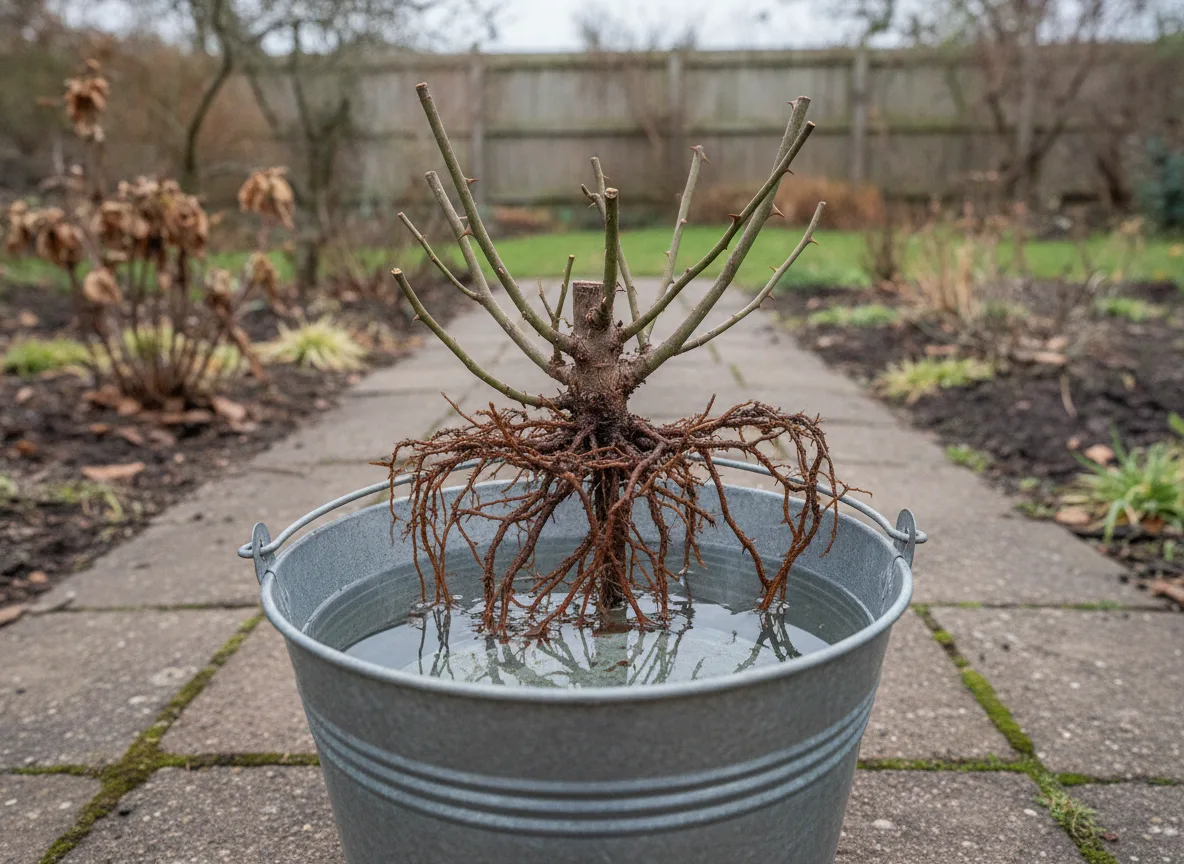 Bare-root rose with clean, soil-free roots soaking in a bucket of water — AI-generated illustration
Before you plant: soak, check, trim the roots
When the parcel arrives, open it the same day. The roots must not dry out; a few hours in a dry wind can kill the fine root hairs.
- Soak the roots. Stand the rose in a bucket of water for at least an hour, or overnight if the roots look dry. Don’t leave it soaking for days.
- Check the roots. Cut back any broken or damaged roots to clean, white tissue, and shorten any very long, straggly root to roughly 20–25 cm so it fits the hole without bending.
- Can’t plant yet? If the ground is frozen or waterlogged, keep the rose wrapped in a cool, frost-free shed for a few days, or “heel it in”: lay it at an angle in a shallow trench of loose soil and cover the roots until conditions improve.
The planting window runs from November to March, whenever the soil isn’t frozen or sodden. Autumn and early winter are the best part of it: the soil is still slightly warm, and the roots start growing well before the leaves do.
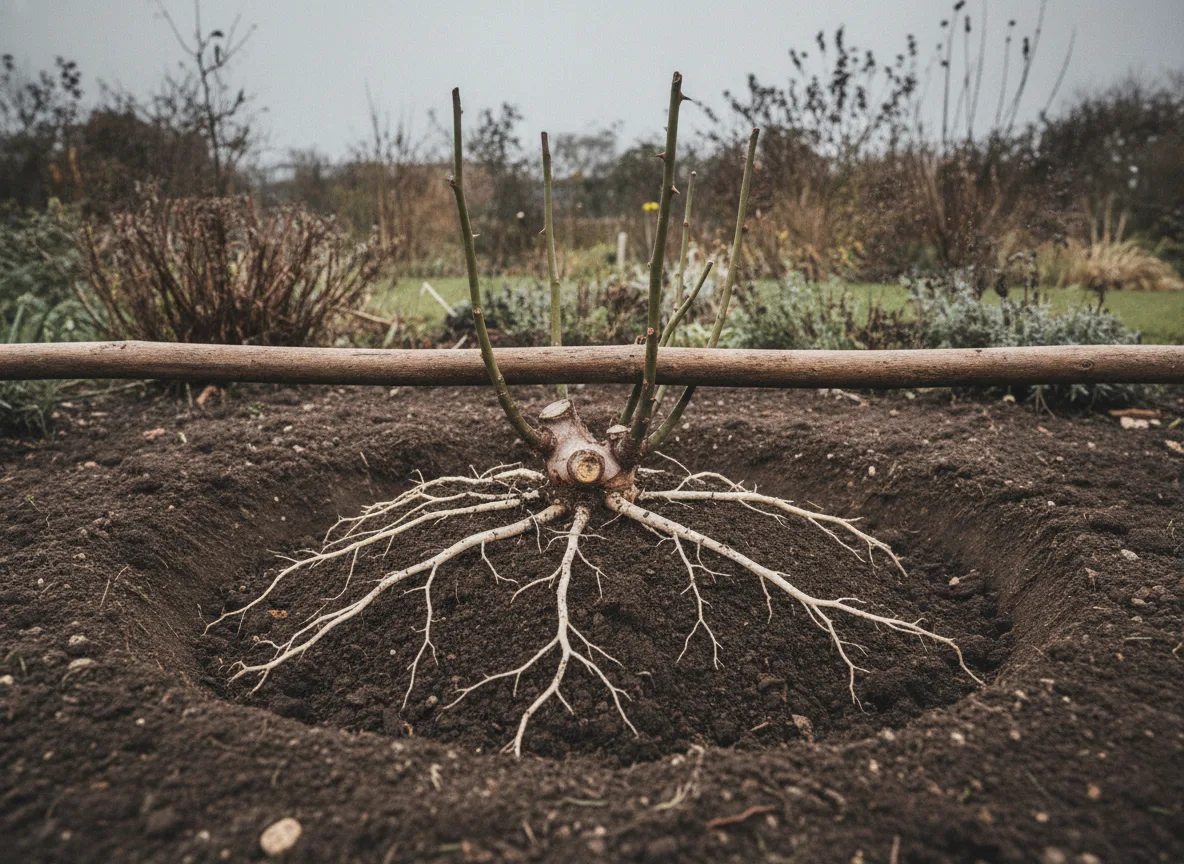 Bare-root rose with its roots spread over a mound in a planting hole, a cane marking soil level — AI-generated illustration
Planting: the graft union and the soil
Most roses are grafted: the variety you bought sits on the roots of a vigorous wild rose. You can see the join, the graft union, as a knobbly bulge where the stems meet the root.
- Dig a wide hole, about 40 cm across and as deep as the roots need. Loosen the bottom with a fork.
- Plant the graft union about 5 cm below the soil surface. Burying it slightly protects it from frost and wind-rock, and it means the rose is less likely to push up suckers from the rootstock. If it does, pull them off rather than cut them.
- Avoid the spot where an old rose grew. Roses planted in soil that held roses for years often struggle (rose replant disease). Choose a fresh spot, or swap out a big hole’s worth of soil.
- Firm in and water well, even in winter. Mycorrhizal fungi sprinkled on the roots can help them establish, but they’re optional.
The hard cut: how far, and when
This is the part that looks like a mistake. Bare-root bush roses (hybrid teas and floribundas) usually arrive already shortened to 20–30 cm. The RHS advice is to go further: cut large-flowered roses back to about 10–15 cm above the ground, and floribundas to about 15 cm. On each stem, cut just above an outward-facing bud, with a slight slope away from the bud.
Why so hard? A newly planted rose has a limited root system and only so much energy to spend. Leave long stems and that energy goes into a few weak shoots near the top. Cut low and the rose responds with strong new canes from close to the base, which gives you a bushy, well-shaped plant from the first summer.
While you’re at it:
- Remove completely any stem that’s dead, damaged or thinner than a pencil.
- Take out any stem that crosses the centre of the bush, so you keep an open cup shape.
At planting or in March? If you plant in spring, make the hard cut straight after planting. For roses planted in November or December, many growers do it in two steps: tidy up any damaged stems at planting, and make the real hard cut in late February or March, just before the buds break. Any tips killed by winter frost go in the same cut. Either way, it’s a one-off: from the second year on, your rose gets the normal late-winter rose prune.
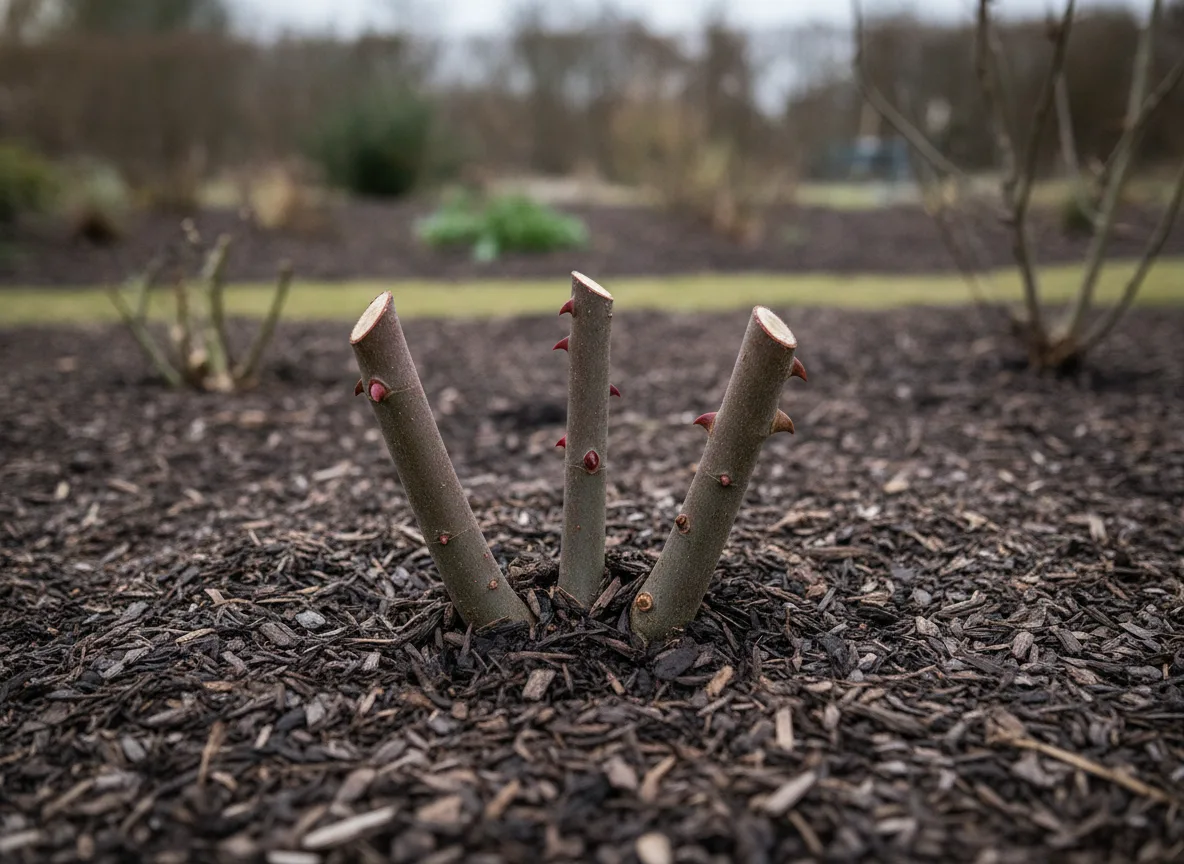 Newly planted bush rose with its stems cut back hard to just above the mulch — AI-generated illustration
Which bare-root roses should not be cut hard
The hard cut is for bush roses. Other types need a much lighter hand.
- Climbing roses: don’t shorten the long stems. They’re the start of your framework, and climbers flower on side shoots from that framework, so a hard cut only delays flowering. Just trim off damaged tips, then tie the stems in as horizontally as you can. Climbing roses keep their frame for life.
- Rambling roses: the same, but even lighter. Remove only what’s broken.
- Shrub and English roses: shorten the stems by about a third to a half at most, and remove anything weak or damaged. A hard cut on a big shrub rose just costs you a season of size.
- Rose hedges (such as Rosa rugosa bought as bare-root hedging): cut back by about a half after planting to make them bush out from the base, much like a newly planted hawthorn hedge.
Quick checklist
- Plant bare-root roses from November to March, when the soil isn’t frozen.
- Soak the roots for an hour, trim damaged roots.
- Graft union about 5 cm below the surface; not where an old rose grew.
- Bush roses: cut back to 10–15 cm (hybrid teas) or about 15 cm (floribundas), to outward-facing buds.
- Climbers and ramblers: tips only. Shrub roses: a third to a half.
- Autumn-planted? Make the hard cut in late February or March.
Not sure which type of rose you’ve bought, or when the cut is due in your area? Add it to your garden in Cresco, and it will remind you when it’s time for that first hard prune.