By August, cutting the vine is how you feed the fruit
A grapevine spends June and July doing one thing with everything it has: growing. Left alone, a single healthy vine will throw out metres of whippy green shoot in a season, and every one of those shoots is a mouth — drawing sugars the plant could otherwise be pouring into the bunches. That’s the whole logic of the August cut. You are not tidying the plant and you are not shaping it. You are cutting off the competition so the sugar goes where you want it: into the grapes.
This is the part most people get backwards. They see the vine looking wild in late summer, panic, and either hack it all back or leave it entirely — and then wonder in September why the bunches are small, green and sour. The vine had the energy. It just spent it on leaves and shoots instead of fruit, because nobody told it where to send it.
The good news is that summer pruning a grapevine is not the delicate, once-a-year event that winter pruning is. It’s a repeated pinch-and-strip you do every week or two through August, and none of it requires you to understand the plant’s full framework. You only need three moves.
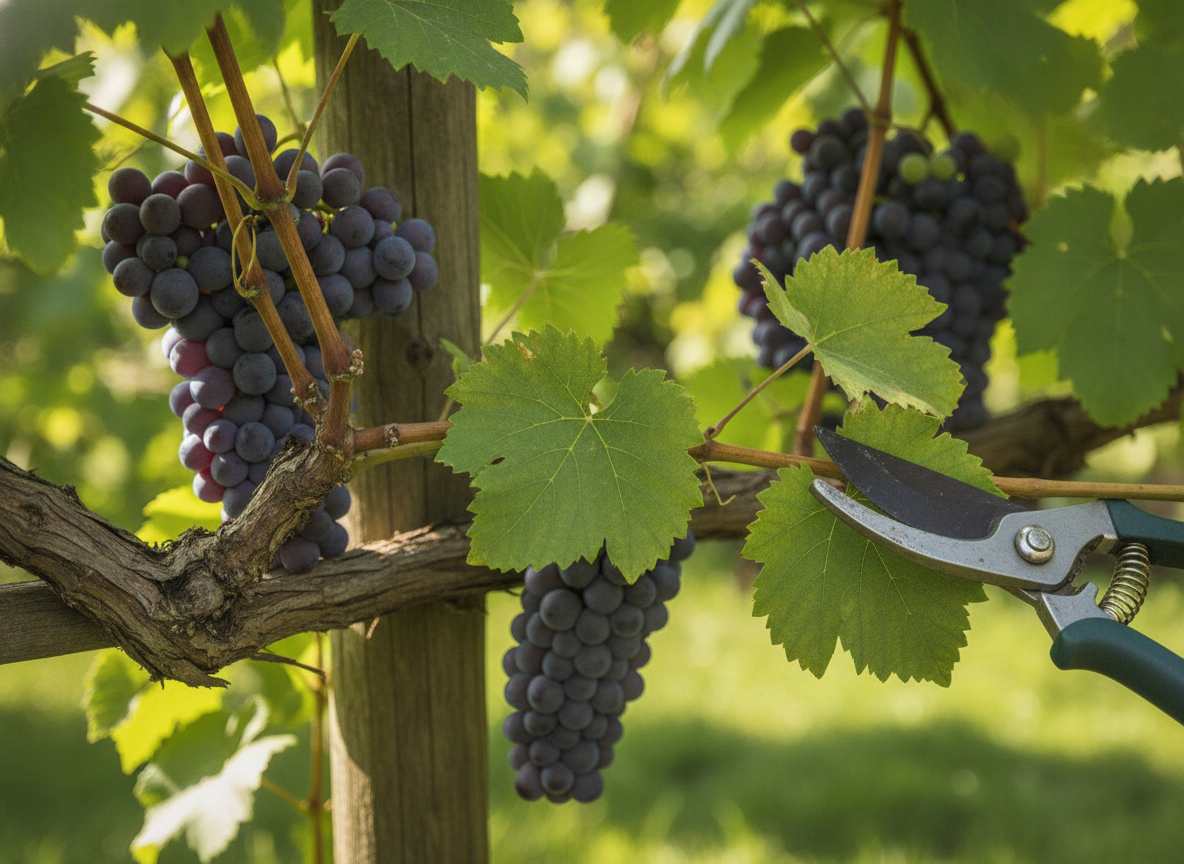 A close-up view of dark grapes on a vine with pruning shears — AI-generated illustration
Move one: stop the fruiting shoots two leaves past the bunch
Find a shoot that’s carrying a bunch of grapes. Follow it out from the bunch toward the growing tip, count two full leaves beyond the last bunch on that shoot, and pinch or snip off everything after that.
Those two leaves are not arbitrary. They’re the ones that shade and feed that particular bunch — enough leaf to ripen the fruit, not so much that the shoot keeps racing away and stealing sugar for its own growth. Cut here and the shoot stops extending; the energy it would have spent on another metre of green now backs up into the grapes below.
Do this to every fruiting shoot on the vine. It feels brutal the first time — you’re removing a lot of healthy growth — but a grapevine has vigour to burn, and this is exactly how commercial vineyards and glasshouse growers have managed vines for centuries. The plant is built to be cut.
Move two: the shoots that keep coming back — sub-laterals to one leaf
Here’s the move nobody warns you about, and the reason August pruning is a habit rather than a one-off. A week after you’ve cut a shoot back, the vine answers by pushing new sideshoots from the leaf joints just below your cut. These secondary shoots — sub-laterals — are the vine’s attempt to replace the growth you removed, and if you ignore them the whole canopy closes back over in a fortnight.
The rule for these is simpler still: cut every sub-lateral back to one leaf. One leaf keeps a little photosynthesis going at that joint without letting the shoot run. You’ll do this two or three times over August as the vine keeps trying, and each time it gives up a little more and puts a little more into ripening. By early September the pushing slows right down.
This is the same principle behind summer-pruning trained apples and pears — cut the leafy sideshoots back in summer and the tree diverts its energy from wood into fruit and next year’s buds. A vine just does it faster and needs the pinch repeated more often.
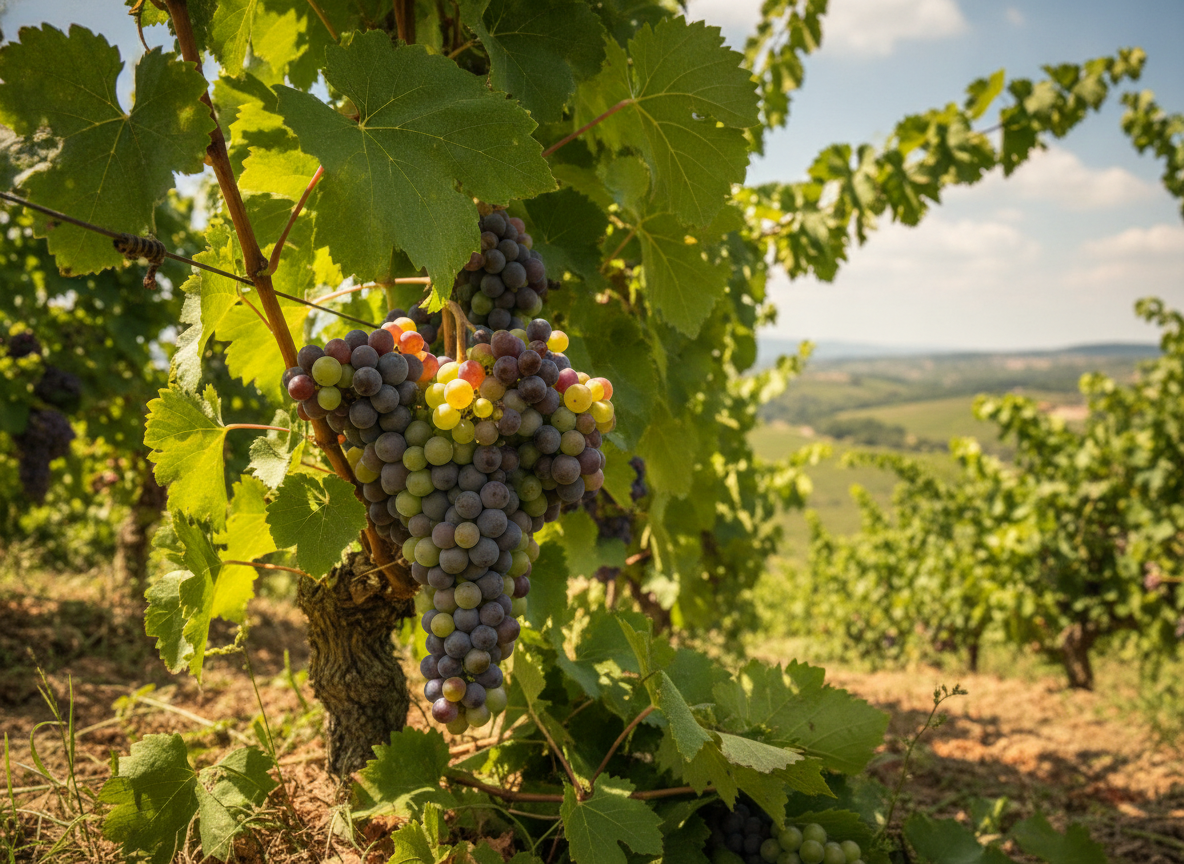 A close-up of ripening grapes on a vine with some leaves removed — AI-generated illustration
Move three: strip the leaves shading the bunch — but not the whole canopy
Grapes need light and moving air on the fruit to ripen and colour, and to stay clear of the grey-mould and mildew that a damp, crowded canopy invites. So from mid-August, once the berries are swelling and starting to soften, remove the leaves that sit directly in front of and over each bunch — the ones casting the bunch into shade.
The mistake is to strip the vine bare in a burst of enthusiasm. The leaves further up each shoot are the factory making the sugar; take too many and you starve the very ripening you’re trying to speed up. Take only the leaves shading the bunches themselves, and lean toward opening the shadier, north-facing side of the vine while leaving more cover on the sun side, where scorch is a real risk on a hot wall. You’re aiming to dapple light onto the fruit, not bake it.
On an outdoor vine in a British or Dutch garden — usually against a warm south or west-facing wall — this leaf-thinning is often what decides whether the grapes actually ripen before the season turns, or hang there stubbornly green.
Thin the bunches too, if you want to eat them
If you’re growing a dessert grape rather than a wine or juice variety, there’s a fourth, optional job that pairs with the pruning: bunch thinning. A vine will happily set far more fruit than it can ever ripen well, and the result is a lot of small, sharp, seedy grapes packed so tightly they rot from the inside.
Earlier in summer — July, when the berries are pea-sized — go through with narrow scissors and thin each bunch, snipping out perhaps a third of the berries from the centre so the rest have room to swell and air can move through. On a young or lightly-grown vine, also limit yourself to one bunch per fruiting shoot. Fewer, larger, looser bunches beat a heavy crop of sour little pellets every time. By August that window has mostly passed, but if you never got to it, thinning out any obviously crowded or mouldy bunches now still helps the rest.
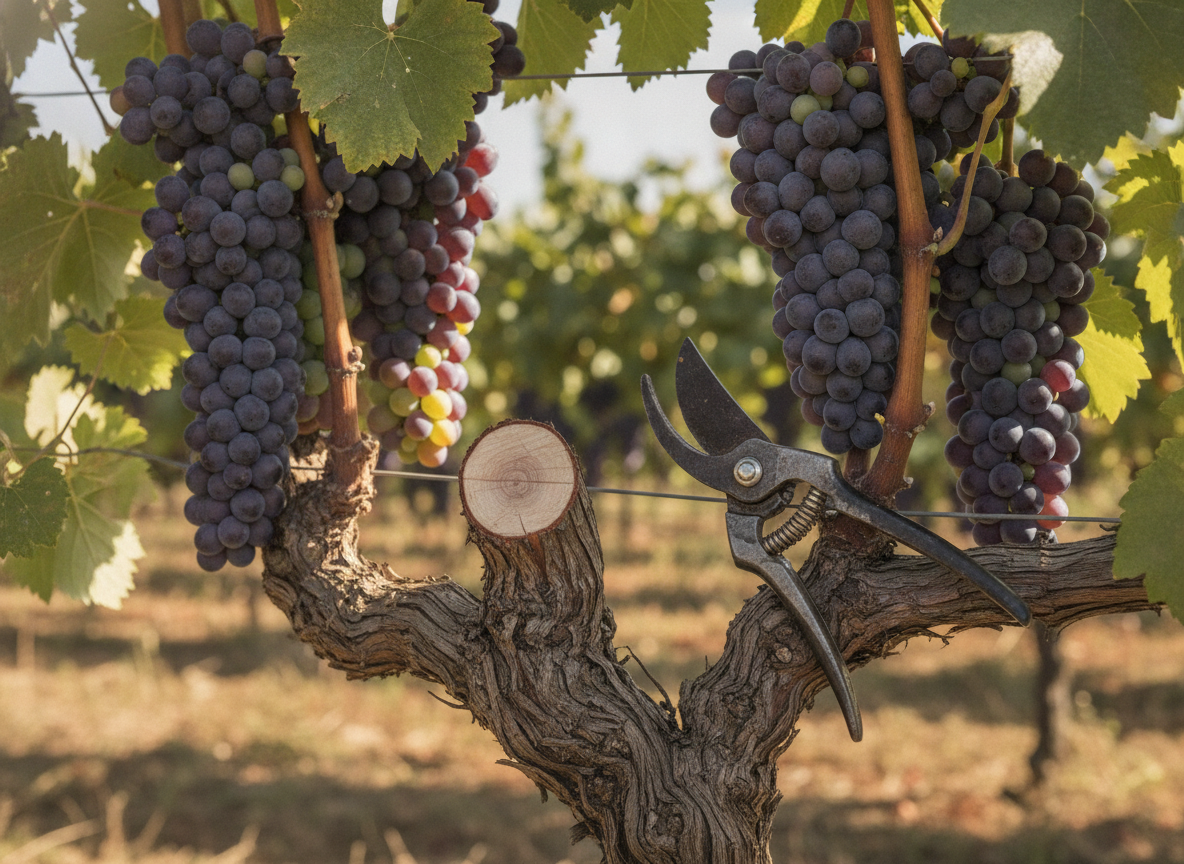 AI-generated illustration
What August pruning is NOT: leave the big cut for winter
This is the one timing mistake that undoes everything. The hard, structural prune — the one where you cut the whole vine back to its permanent framework of rods and short spurs — is a winter job, done in the depths of dormancy, and it must never be attempted now.
The reason is sap. A grapevine cut in late summer or autumn, while it’s still in full growth, will “bleed” — sap runs from the wound and won’t stop, weakening the vine and inviting disease. Wait until the vine is fully dormant and leafless, deep in winter (December into January in most gardens), before making any large cut back to the framework. Cut a dormant vine and the wounds stay dry. Cut a growing one and they weep.
So the year splits cleanly in two: the summer work is the light, repeated pinch-and-strip described above, aimed at ripening this year’s fruit; the winter work is the single hard cut back to the framework, aimed at setting up next year. Do the summer pinching now and the winter cut in January, and never let the two swap places. It’s the same discipline that governs wisteria’s twice-a-year prune — a summer cut to five leaves to build flowering spurs, then a harder winter cut once the plant is bare.
The short version
Through August, walk the vine every week or two and do three things: shorten each fruiting shoot to two leaves past its bunch, cut every fresh sub-lateral back to one leaf, and strip the leaves directly shading the bunches. Leave the big framework cut for a dormant winter day. That’s the whole rhythm — small, repeated, and aimed entirely at pushing sugar into the fruit.
Getting the when right is most of the battle, and a grapevine’s “pinch in summer, cut hard in winter, never the reverse” is exactly the kind of split-season rule that’s easy to muddle. The Cresco pruning calendar keeps each plant’s timing straight for you, judged against your own local season rather than a generic date — grapevine included.