The red is the new growth — so you have to keep making new growth
The flame-red leaves everyone plants Photinia × fraseri ‘Red Robin’ for are not the mature foliage. They’re the brand-new shoots. A Red Robin leaf is bright red for a few weeks, then settles into glossy dark green as it hardens off. By midsummer, an untrimmed plant is a wall of green with a thin band of colour only at the very tips.
The trick is simple once you see it: every cut you make forces the plant to break new shoots below the wound, and every one of those shoots comes out red. So the way to keep a Photinia glowing is not to leave it alone — it’s to prune it two or three times a year, on purpose, to trigger fresh flushes. The spring cut gives you the big April–May show. A second cut in June gives you a whole new wave of red for the second half of summer, right when the spring flush has gone green and dull.
That’s why mid-June matters. Miss it and you get one short burst of colour a year. Take it and the plant carries red into August.
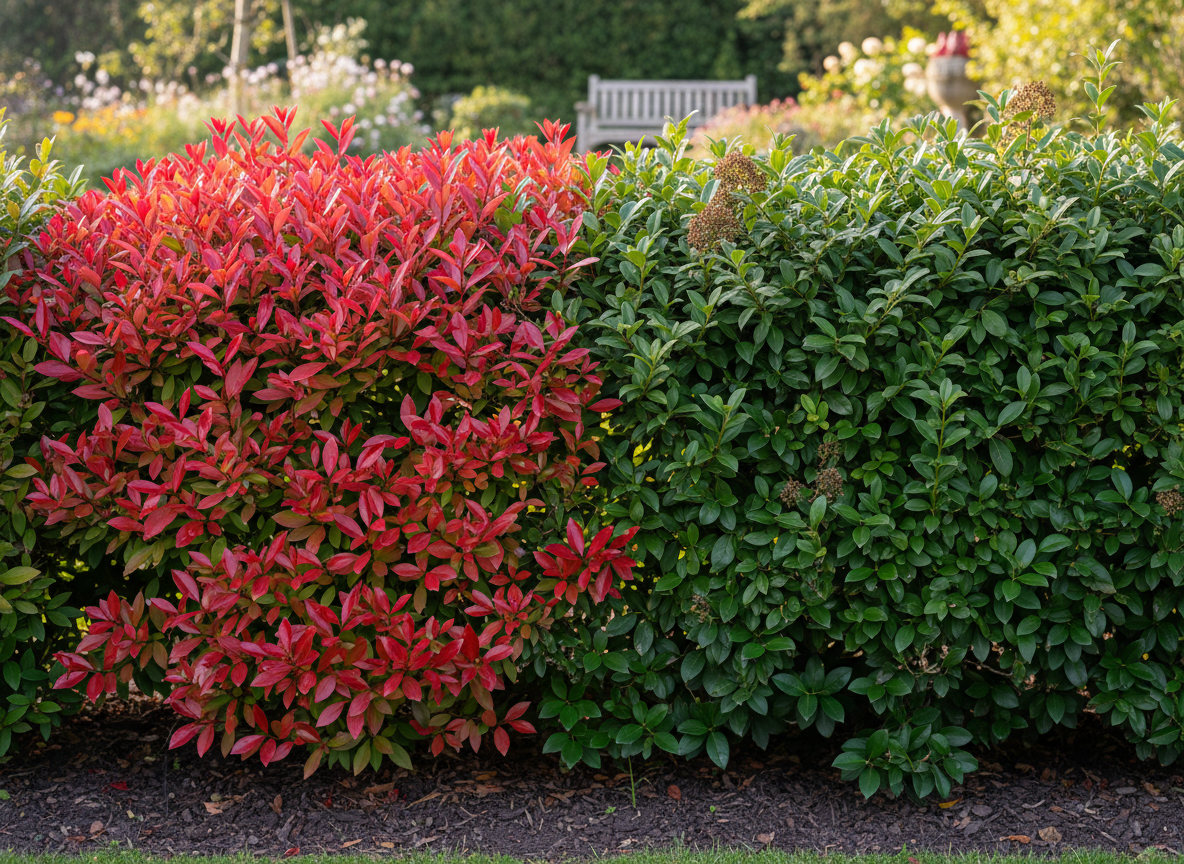 A hedge with vibrant red foliage on the left and green foliage on the right — AI-generated illustration
The mid-June window — and the mid-August cutoff
There are two reliable pruning slots for Red Robin in the UK: early spring (March–April) and early-to-mid summer (June–July). You’re in the second one now.
The summer trim does two jobs at once. It tidies the shape after the spring growth has lengthened and started to flop, and it kicks out that second flush of red. A plant trimmed around now will be colouring up again within two to three weeks.
The one hard rule is the other end of the season: stop pruning after mid-August. Any later and the soft red regrowth won’t harden before the first autumn frosts, and you’ll watch it blacken and die back. So June and July are for cutting freely; from late August onwards, leave it alone and let the plant batten down for winter.
If you only ever do one summer trim, do it now rather than in July — an earlier cut gives the new growth longer to mature and look its best before the colour stops coming.
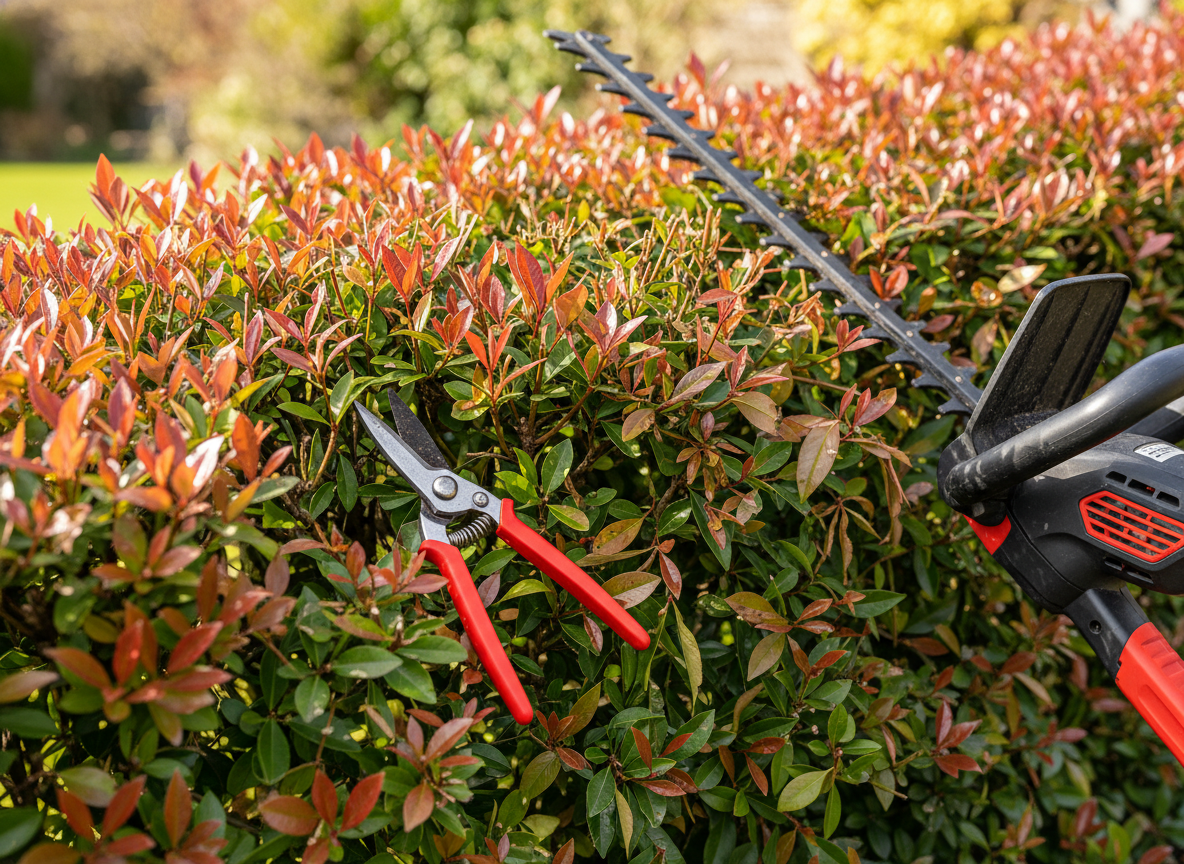 Secateurs and a hedge trimmer are positioned next to a photinia hedge — AI-generated illustration
How far to cut — and why secateurs beat the hedge trimmer
For a flush of colour rather than a hard reshape, you don’t need to take much. Shortening the season’s new shoots by 10–15 cm is plenty: it removes the green, leaves a bud lower down to break, and keeps the plant dense rather than leggy. Cut just above an outward-facing leaf or bud so the new shoot grows away from the centre and lets light in.
If a plant has got too big or bare at the base, Photinia is forgiving — it breaks readily from old wood, so you can cut harder, even back into bare stems, and it will reshoot. But do the heavy renovation work in spring, not now. In June, keep it to a light shortening so the regrowth has the warm weeks it needs.
The tool matters more than you’d think. Use secateurs, not a hedge trimmer or shears. A hedge trimmer slices straight through the large leaves, and every cut leaf-half then browns at the severed edge — so a freshly “tidied” Photinia hedge ends up speckled with scorched-looking margins for weeks. Cutting back to a stem with secateurs leaves no cut leaves on show. It’s slower, yes, but it’s the difference between a hedge that looks clipped and one that looks burnt. On a long hedge, at least cut the outer face by hand even if you run a trimmer over nothing.
A second small reason to favour clean secateur cuts: Photinia can be hit by leaf spot and, occasionally, fireblight. Clean blades and tidy cuts that don’t leave torn, dying leaf tissue give disease less to get into. Wipe the blades between plants if you know you’ve got leaf spot about.
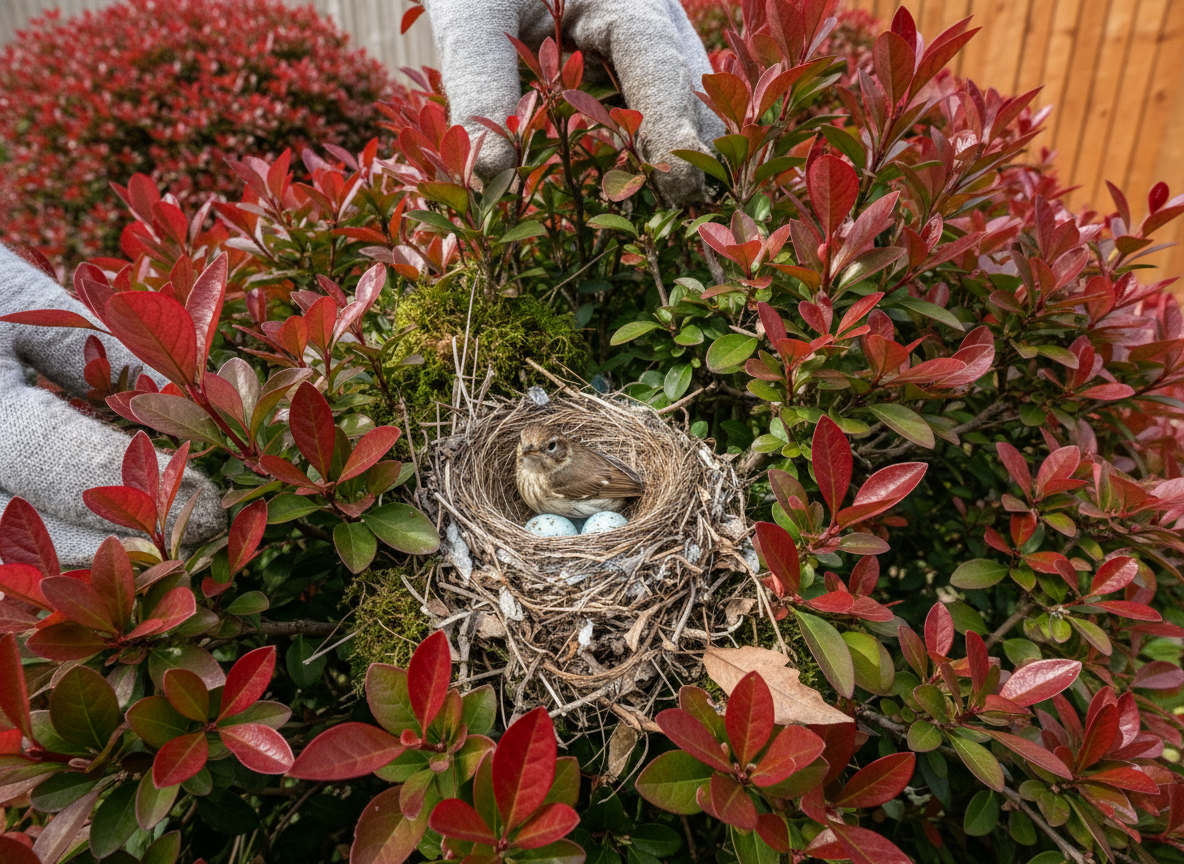 A bird and eggs are in a nest within a photinia bush — AI-generated illustration
Check for nesting birds before you start
Mid-June is still firmly inside the bird-nesting season, and dense evergreen hedges like Red Robin are prime nesting sites. Before you trim a hedge, part the foliage and check — it’s both the decent thing to do and, in the UK, an active nest is legally protected. If you find one, leave that section and come back in July once the young have fledged. A few weeks’ delay costs you nothing; the plant will still flush.
Feed, water, and let it run
A cut is a demand for regrowth, so give the plant what it needs to answer. After trimming, a light feed of a balanced general fertiliser and a good soak in dry spells will fuel a stronger, redder flush than a stressed, dry plant can manage. A mulch around the base in June helps hold that moisture through the summer.
Then leave it to do its thing. Within a fortnight you’ll see the red coming back, and you’ll have earned a second season of the colour you planted it for — without the scorched-leaf look that gives away a rushed hedge-trimmer job.
For another evergreen that rewards a careful early-summer cut on a cloudy day, see the Derby Day box trim, and if you’re timing a deciduous hedge in the same fortnight, the late-June beech window covers that. Want every plant in your garden to tell you its own cut-and-feed window? Cresco builds the calendar for you.