By the last week of July the bee balm that carried those shaggy, firework flowers all through the month starts to turn on you. The blooms fade to brown tufts, and the leaves below them go dull, then grey, then powdery — a dusting of white that spreads up from the base until half the plant looks as if someone shook flour over it. Most gardeners write it off as bad luck, or the weather, or “just what Monarda does.” It isn’t any of those. It’s a signal about how the plant has been living, and the fix is a pair of secateurs and a job you can finish in ten minutes this week.
Why bee balm mildews when the plant next to it doesn’t
Powdery mildew on most plants is a damp-and-crowded problem — spores love still, humid air trapped in dense foliage. Bee balm has that going on too, but it carries a second trigger that catches people out: dry roots. Monarda is a streamside plant by origin, happiest with its feet in consistently moist ground. Let it dry out at the root — a hot July, a spot near a hungry hedge, a season you forgot to water — and the plant goes into stress, and stressed Monarda mildews almost on cue. So the classic mildewed clump is the opposite of what you’d expect: not a plant that’s too wet, but one that’s too dry underground while its leaves sit in stale summer air.
That combination explains why the mildew always starts low and on the inside. The lower leaves are the oldest, the most shaded, and the furthest from what little moisture the roots are pulling up. They grey over first, and by the time the white reaches flowering height the whole lower half of the plant is a spent, infected mass that no spray is going to bring back. Fungicides at this stage are a waste — you’d be painting over leaves the plant has already finished with.
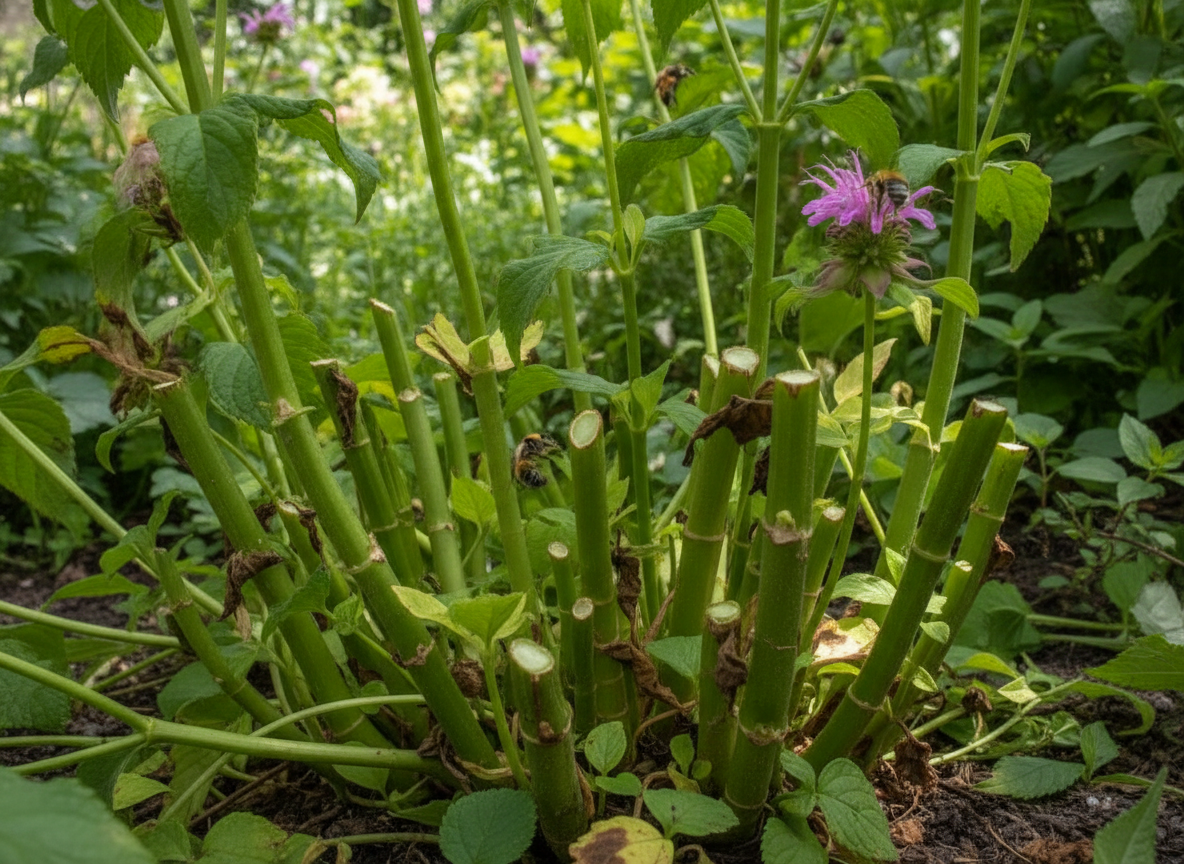 A bee balm plant is cut back to fresh green shoots in a garden — AI-generated illustration
The late-July cut: take it right back to the fresh shoots
Here’s the move. Look down into the base of the clump, under the tired flowered stems, and you’ll almost always find new shoots already breaking from the crown — short, clean, green, untouched by the white. That fresh growth is the whole reason this cut works. Cut every flowered, mildewed stem right down to just above those basal shoots — a hand’s-width off the ground. Don’t tidy the tops and leave the stems; a headless mildewed stem is still a reservoir of spores standing in your border. Take the lot.
It looks drastic. You’re reducing a chest-high plant to a low green cushion in one go, and the first time you do it your instinct fights you. But bee balm is a tough, spreading perennial with plenty of season left, and cut back to clean shoots in late July it rebuilds fast: within two to three weeks you get a mound of fresh, mildew-free foliage, and in a decent summer a lighter second flush of flower to carry into September. This is the same logic that gives aquilegia a mildew-free summer after an early-June cut to the ground — you’re not saving the infected growth, you’re trading it for clean growth the plant already has waiting.
One thing that matters more than usual with mildew: don’t compost the cuttings, and don’t leave them lying. Powdery mildew overwinters on debris, and a pile of infected stems by the border is next year’s outbreak sitting in wait. Bag them for the council green waste or burn them, and give the secateurs a wipe before you move to the next plant.
 AI-generated illustration
Deadhead or cut back? Read the plant first
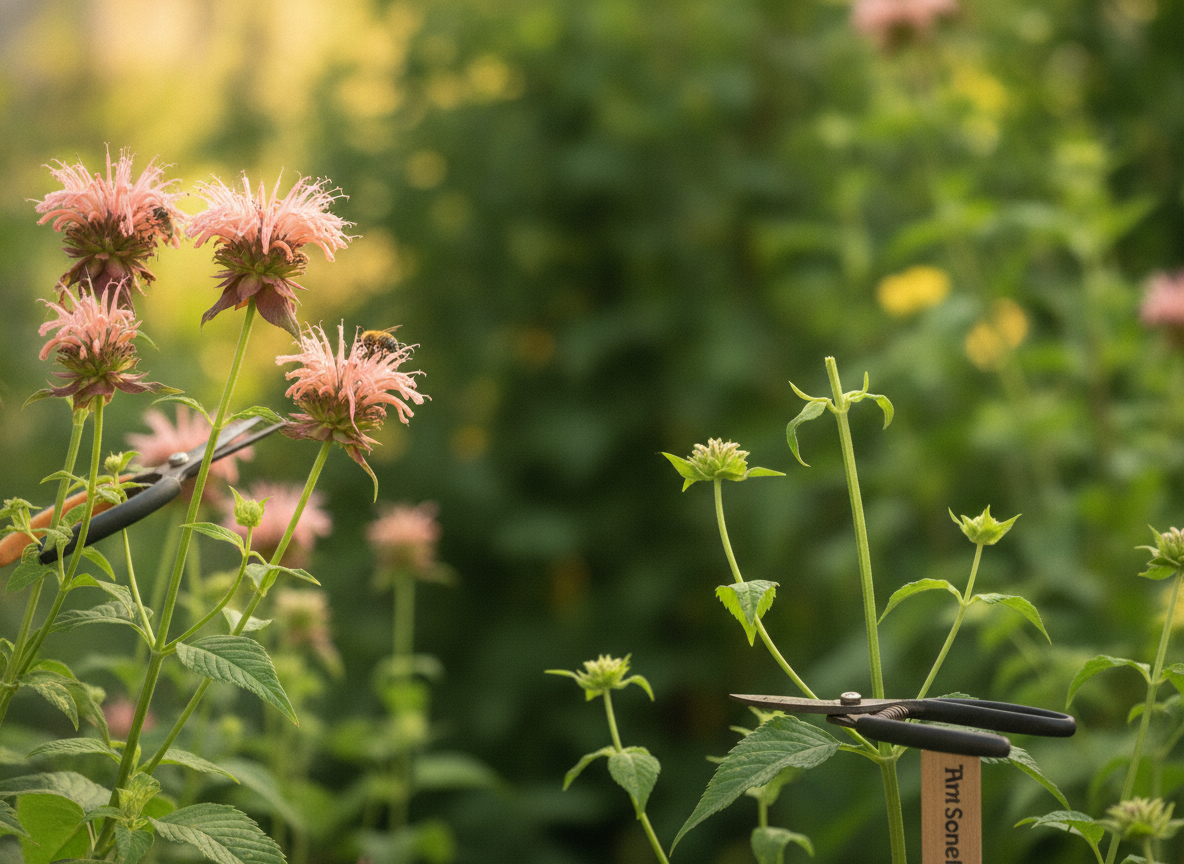
Not every bee balm needs the hard cut in July. The clue is the leaves, not the flowers. If the clump is still flowering well and the foliage is clean and green, don’t chop it — just deadhead the spent flower heads down to the next pair of leaves or a side bud, the same way you’d keep any repeat-flowering perennial going, and let it run. Plenty of well-watered Monarda in good soil sails through July with barely a fleck of white.
The hard cut is specifically for the plant that’s greying from the base up — where the mildew has taken the lower half and deadheading would just leave you with clean flowers on top of a diseased column. When you see that, stop deadheading and take the whole thing down. It’s the July version of the Hampton Hack, the midsummer reset that buys tired perennials a fresh second act, and it belongs in the same family as shearing catmint to the ground for a clean second flush.
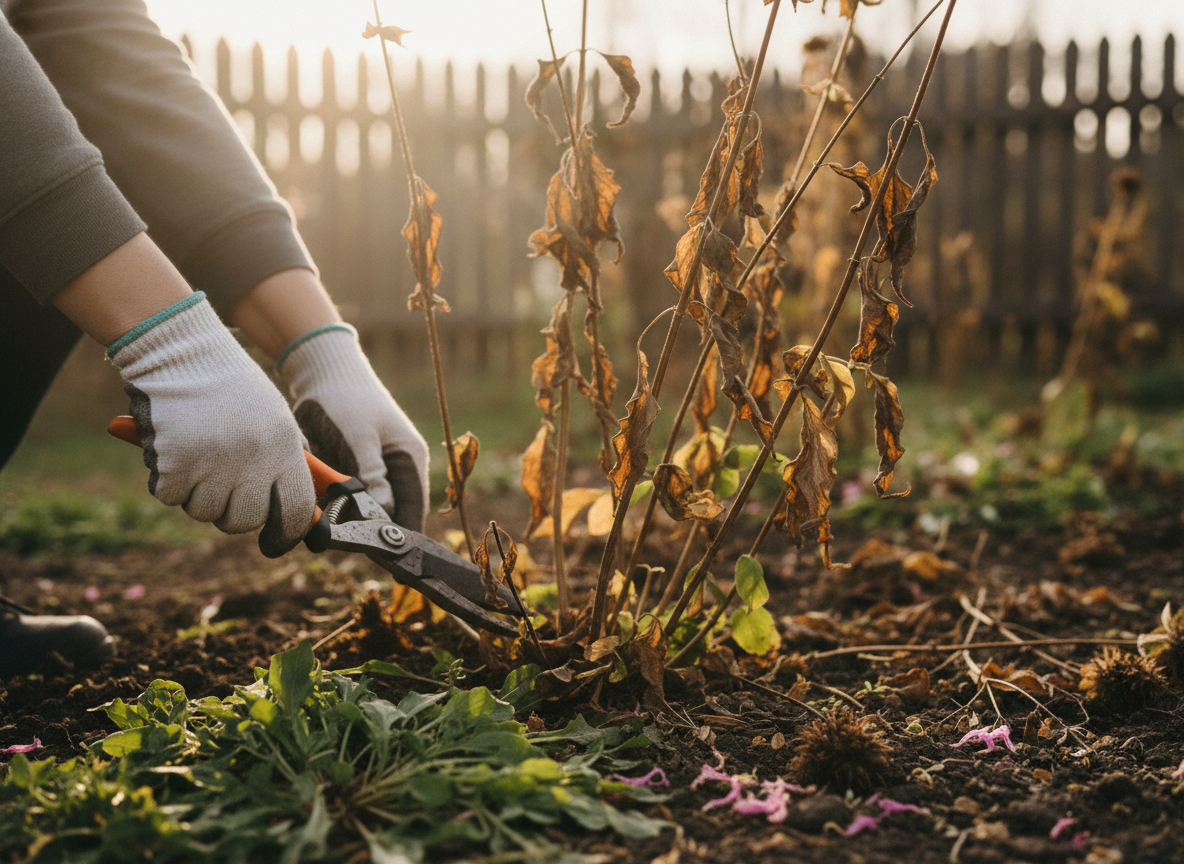 . Hands in gardening gloves pruning dead bee balm plants — AI-generated illustration
Stop it coming back next year
The July cut rescues this season. A few changes stop you needing it every year:
- Keep the roots damp. This is the big one for Monarda specifically. A deep soak in dry spells and a mulch in spring do more to prevent mildew than any spray — a plant that never dries out never hits the stress that triggers it.
- Give it air. Plant so mature clumps don’t touch their neighbours, and thin congested stems in spring so light and air move through the middle. Crowding is what turns a few grey leaves into a whitewashed plant.
- Divide every three years. Bee balm runs outward and the centre gets woody, dense and airless — exactly the still, shaded conditions mildew wants. Lift and split the clump in spring, replant the vigorous outer pieces, and bin the tired middle.
- Choose a resistant variety. If yours mildews every single year whatever you do, replace it. Cultivars like ‘Gardenview Scarlet’, ‘Marshall’s Delight’, ‘Jacob Cline’ and ‘Raspberry Wine’ shrug off mildew far better than the old species and the cheap seed strains.
Let Cresco tell you when to make the cut
The hard part isn’t the cut — it’s reading the plant and catching the moment: the week the first flush goes over and the base starts to grey, which shifts by a fortnight or more depending on your summer and your soil. Cresco tracks that for every plant in your garden, watches your local weather, and tells you when a plant like bee balm is ready for its reset — so you cut clean growth back at the right time instead of noticing a white, spent clump three weeks too late. You can see how the whole approach works in the Cresco pruning calendar that reads every plant against your local weather.
Cut it back this week, keep the roots wet, and the bee balm you were ready to give up on is a fresh green mound again by August — mildew gone, and flowering into the autumn.